About 699 minutes
State of the Union Addresses — A Closer Reading
Government
160,715 recorded words. 15 minutes difference from this book's estimate.
View Gutenberg source #5032
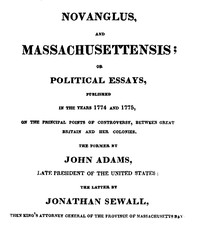
This digital edition of Novanglus, and Massachusettensis or, Political Essays, Published in the Years 1774 and 1775, on the Principal Points of Controversy, between Great Britain and Her — Key Ideas to Explore is described by source-level measurements including 157,309 words, 11 hr 24 min estimated reading time, and 14 detected text sections.
The text analysis averages about 27.0 words per sentence, while the detected sections provide another way to judge how the source is divided.
Project Gutenberg metadata also associates the work with “United States -- Politics and government -- 1775-1783,” connecting these edition facts with the source record’s subject description.
Explore this collection
These alternatives are selected using recorded categories and estimated reading time.
About 699 minutes
Government
160,715 recorded words. 15 minutes difference from this book's estimate.
View Gutenberg source #5032About 645 minutes
Government
148,260 recorded words. 39 minutes difference from this book's estimate.
View Gutenberg source #23097About 629 minutes
Government
144,665 recorded words. 55 minutes difference from this book's estimate.
View Gutenberg source #35172Search stored excerpts and compare books → Choose by your preferences →
Choices use stored catalog measurements. Estimates vary with reading speed. A shared category is a catalog label, not a claim that two books have the same argument or literary quality.
Search reads excerpt text stored with this catalog and links to its associated Gutenberg record. The connection is stored in the site database; this tool does not recheck that every excerpt is word-for-word identical to that external record. Excerpt search does not cover every chapter and does not verify historical publication dates.
Catalog snapshot checked: 2026-09-25. Coverage: 90 public books, 90 available source excerpts.
Read the complete public-domain text at its original source.
Read on Project GutenbergThe volume pairs two opposing series of newspaper essays—John Adams's Novanglus and Jonathan Sewall's Massachusettensis—that appeared in Boston newspapers during the winter of 1774–1775. Rather than a single narrative, the book presents a direct, serialized debate over the constitutional relationship between Great Britain and the colonies. The structure is unusual: each writer responds to the other's previous installment, creating a back-and-forth that mirrors the escalating crisis. Readers encounter not only arguments but also the rhetorical strategies each author uses to frame the same events—such as the destruction of the tea—from opposing perspectives.
The book's organization is defined by its origin as a newspaper exchange. Massachusettensis (Sewall) writes first, addressing the inhabitants of Massachusetts Bay, and Novanglus (Adams) replies in subsequent issues. This serial structure means that each essay assumes knowledge of the opponent's previous points, creating a layered argument that builds over time. The reader must track both sides simultaneously, as each writer reframes the other's claims. For instance, Sewall describes the tea destruction as a violent attack on property, while Adams later treats it as a justified protest. The format forces the reader to weigh competing interpretations of the same event.
Both authors rely on a shared metaphor: the political situation as a plant or tree. Sewall warns that sedition began as a small seed, like a grain of mustard, and has grown into a great tree with vile reptiles at its root and foul birds in its branches. He urges readers to cut it down with axes and hatchets. Adams, in his responses, does not directly echo this image but engages with the idea of growth and consequence. The metaphor recurs across the essays, giving the debate a consistent visual language. Sewall's tree is a pest; the implication is that Adams's position is a dangerous growth that must be eradicated before it is felled by a stronger arm.
The essays shift between concrete events—the Tea Act, the blockade, the destruction of the tea—and broader constitutional arguments about parliamentary authority and colonial rights. Sewall, for example, moves from the tea destruction to a discussion of the mixed government of England and the importance of commerce. Adams similarly ties local grievances to fundamental principles of governance. This movement between the particular and the general is a structural feature: each writer uses a specific incident as a springboard for a larger claim about sovereignty. The reader must follow these transitions closely, as the same event is used to support opposing constitutional theories.
Each essay is framed as a direct address to the inhabitants of Massachusetts Bay. Sewall opens with a personal appeal, identifying himself as a native who has watched the political maneuvers of the province. He claims to write from gratitude and patriotism, not party loyalty. Adams, writing as Novanglus, adopts a more analytical tone but also speaks directly to the same audience. This rhetorical stance creates a sense of immediacy and urgency, as if the writers are speaking to the reader in real time. The repeated use of "my dear countrymen" and similar phrases reinforces the idea that the debate is not abstract but concerns the fate of the province itself.
Because the essays were written in direct response to one another, the best approach is to read them in the order they were published, alternating between the two authors. Pay attention to how each writer reinterprets the same event—the destruction of the tea, the blockade—to support his argument. The recurring plant metaphor and the shift from specific incidents to constitutional principles are key to understanding the structure. The volume also includes later letters by Adams, which provide retrospective commentary on the debate.
Leafing through Adams and Sewall’s arguments about planting colonies, I found myself dwelling on the patient, seasonal trust in their metaphors. That same steady faith in gradual growth surfaced while reading State of the Union Addresses — Background and Themes, where each year’s message feels less like a declaration and more like a gardener checking the same stubborn soil, quietly expecting another spring.
Use these questions to collect your thoughts before moving on.









