About 408 minutes
Under the Prophet in Utah; the National Menace of a Political Priestcraft — Context and Discussion
Government
93,802 recorded words. 15 minutes difference from this book's estimate.
View Gutenberg source #7066
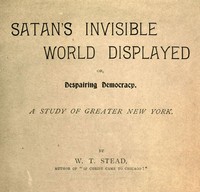
Before opening Satan's Invisible World Displayed; or, Despairing Democracy A Study of Greater New York — Reading Notes, the edition data offers a quick orientation: 90,329 words, 6 hr 33 min estimated reading time, and 14 detected text sections.
The text analysis averages about 23.4 words per sentence, while the detected sections provide another way to judge how the source is divided.
Project Gutenberg metadata also associates the work with “Police -- New York (State) -- New York,” connecting these edition facts with the source record’s subject description.
Explore this collection
These alternatives are selected using recorded categories and estimated reading time.
About 408 minutes
Government
93,802 recorded words. 15 minutes difference from this book's estimate.
View Gutenberg source #7066About 425 minutes
Government
97,702 recorded words. 32 minutes difference from this book's estimate.
View Gutenberg source #14518About 360 minutes
Government
82,627 recorded words. 33 minutes difference from this book's estimate.
View Gutenberg source #10366Search stored excerpts and compare books → Choose by your preferences →
Choices use stored catalog measurements. Estimates vary with reading speed. A shared category is a catalog label, not a claim that two books have the same argument or literary quality.
Search reads excerpt text stored with this catalog and links to its associated Gutenberg record. The connection is stored in the site database; this tool does not recheck that every excerpt is word-for-word identical to that external record. Excerpt search does not cover every chapter and does not verify historical publication dates.
Catalog snapshot checked: 2026-09-25. Coverage: 90 public books, 90 available source excerpts.
Read the complete public-domain text at its original source.
Read on Project GutenbergW. T. Stead opens Satan's Invisible World Displayed by framing it as a departure from his usual annual romance, substituting a factual survey of New York City's political corruption. The book draws heavily on testimony from the Lexow Committee, a state investigation that exposed systematic bribery and collusion between police and criminals. Stead argues that the revelations are so startling that they surpass fiction, and he connects the corruption to a broader despair about democratic governance, citing ex-Governor Altgeld's warning that corrupt greed threatens the Republic.
The excerpts show that Stead relies almost entirely on the Lexow Committee's published testimony, often citing specific volumes and page numbers. For instance, he references volume five, page 5,193, to describe a dispute between thieves over territorial rights. This reliance on official records gives the book a documentary quality, but it also means the narrative is shaped by the committee's focus. Stead does not provide independent verification; instead, he selects and arranges evidence to support his thesis that New York's police acted as protectors of crime rather than enforcers of law.
Stead introduces the term Pantata, a Bohemian word meaning father-in-law, which the Lexow Committee brought into English. He explains that it was used by the Bohemian Liquor Dealers' Association to refer to the police captain of their precinct. The captain became a paternal figure who relaxed laws in exchange for payments. Stead emphasizes the irony: instead of being a terror to evildoers, the police captain acted as a father-in-law to criminals. He provides a concrete example: Anna Newstatel, whose licence was revoked, was allowed to continue selling liquor without a licence after paying an initiation fee of $200 and $50 monthly to the police.
One of the most striking details in the excerpts is the police's respect for territorial jurisdiction among criminals. Stead reports that Broadway was parcelled into blocks, each assigned to a different thief who paid rent to the police. The police would arrest a thief only if a complaint was made; otherwise, they would 'close the other eye.' This system created a bizarre order where thieves fought over boundaries and police threatened to send a thief 'up the river' for trespassing. Stead notes the irony that the New York police were as opposed to poaching as English gamekeepers.
Readers should approach this book as a primary source for understanding late-19th-century American municipal corruption, but with the caveat that Stead's selection of evidence serves a polemical purpose. The excerpts suggest a work that is more compilation than analysis, though the vivid testimony and Stead's framing make it a compelling document of its time. Those interested in the Lexow Committee or the history of police reform will find it especially valuable.
Reading Stead's despairing catalog of old New York, I found myself thinking how quickly reform becomes a forgotten language. There's a melancholy kinship with that earlier Connecticut address, wondering if a new constitution might cure what ails a people. Both feel like letters from a previous century, hopeful and tired at once. Count the Cost An Address to the People of Connecticut, On Sundry Political Subjects, and Particularly on the Proposition for a New Constitution — Text and Context sits beside it on my shelf now, two quiet voices asking if we ever learn.
Create a short personal record of your experience with this book.









