About 100 minutes
State of the Union Addresses — Background and Themes
Government
22,887 recorded words. 1 minutes difference from this book's estimate.
View Gutenberg source #5043
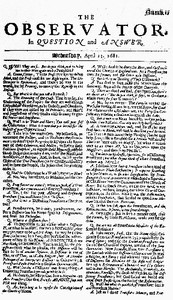
Selections from the Observator (1681-1687) — Text and Context can be approached with a clearer sense of reading commitment from its source measurements: 22,554 words, 1 hr 39 min estimated reading time, and 3 detected text sections.
The text analysis averages about 24.2 words per sentence, while the detected sections provide another way to judge how the source is divided.
Project Gutenberg metadata also associates the work with “Character sketches -- Early works to 1800,” connecting these edition facts with the source record’s subject description.
Explore this collection
These alternatives are selected using recorded categories and estimated reading time.
About 100 minutes
Government
22,887 recorded words. 1 minutes difference from this book's estimate.
View Gutenberg source #5043About 109 minutes
Government
24,909 recorded words. 10 minutes difference from this book's estimate.
View Gutenberg source #5037About 89 minutes
Government
20,425 recorded words. 10 minutes difference from this book's estimate.
View Gutenberg source #5041Search stored excerpts and compare books → Choose by your preferences →
Choices use stored catalog measurements. Estimates vary with reading speed. A shared category is a catalog label, not a claim that two books have the same argument or literary quality.
Search reads excerpt text stored with this catalog and links to its associated Gutenberg record. The connection is stored in the site database; this tool does not recheck that every excerpt is word-for-word identical to that external record. Excerpt search does not cover every chapter and does not verify historical publication dates.
Catalog snapshot checked: 2026-09-25. Coverage: 90 public books, 90 available source excerpts.
Read the complete public-domain text at its original source.
Read on Project GutenbergThe Observator papers, written solely by Sir Roger L'Estrange between 1681 and 1687, adopt a distinctive question-and-answer format that mimics street-corner debate. Two unnamed speakers—a blunt, aggressive informant and a skeptical questioner—drive each exchange. The excerpts show the informant boasting of his influence over witnesses, juries, and elections, while the questioner probes his methods. This structure allows L'Estrange to dramatize political arguments while deflecting criticism through the questioner's voice.
The Observator relies on a two-speaker dialogue: one voice is coarse and self-aggrandizing, the other skeptical but often yielding. In the excerpt, the informant claims to oversee “Witnesses, Jurys, Choice of City-Officers, Election of Members to serve in Parliament,” while the questioner interjects with challenges like “d'ye take this to be fair dealing.” This format lets L'Estrange present controversial assertions as the informant's boasts, then partially rebut them through the questioner—yet the informant always has the last word. The effect is a controlled ventriloquism: the reader is guided to reject the questioner's scruples and accept the informant's cynical realism as truth.
L'Estrange repeatedly deploys coarse bodily references to degrade opponents. The informant recalls an “Outlandish Doctor” who threatened to “let down his Breeches and shite upon” a magistrate, and the questioner retorts with “sluttery a part.” Elsewhere, the informant describes a servant “so set upon his Guts” that he neglected his task. These scatological jabs serve a dual purpose: they align the informant with plain-speaking common sense (“Plain-dealing's a Jewell”) while associating adversaries with filth and disorder. The imagery is not incidental but structural, recurring across dialogues to reinforce the Tory claim that Whig opponents are physically and morally foul.
Despite his vulgarity, the informant presents himself as indispensable to the realm. He claims “the stress of the whole Government lyes in a manner upon my shoulders” and laments being “Harrass'd” to the point of contemplating retirement to a country estate. This self-portrait—a weary patriarch forced into public service—contrasts sharply with his boasts of manipulating legal processes. The questioner occasionally punctures this pose, asking “How is it possible for you to go thorough with all your Writing-work?” Yet the informant never admits incompetence; instead, he blames unreliable underlings. This tension between self-importance and actual behavior is a key rhetorical device, inviting readers to see the informant as both necessary and abused.
The dialogues shift rapidly between settings: a tavern, a courtroom, a private house. The informant recounts a failed plot to ambush a man at a dinner table, then pivots to a story about a tailor cheated by a false oath. These abrupt transitions mimic oral gossip and keep the reader off-balance. L'Estrange also varies register from legal jargon (“Certiorari-men”) to colloquial insults (“Tory-Crackfarts”). This movement creates a sense of immediacy and authenticity, as if the reader is overhearing a real argument. The effect is to blur the line between reported fact and partisan invention, making the Observator a performance of political theater rather than straightforward news.
Readers approaching these selections should attend to the interplay between the two voices and the recurring motifs of bodily disgust and legal manipulation. The excerpts offer only fragments of a longer serial; L'Estrange's arguments often depend on knowledge of specific events and persons. Treat the dialogues as rhetorical constructs rather than transparent records. The introduction by Violet Jordain provides helpful context on L'Estrange's career and the political climate of the 1680s.
There’s something almost tender about L’Estrange’s grubby jabs, that beleaguered voice shouting into the void. It makes me think of quieter days, wandering provincial France in 1889, where the political stakes felt similarly raw but somehow more hopeful. That old record still sits on my shelf, a curious companion to these combative papers. France and the Republic A Record of Things Seen and Learned in the French Provinces During the 'Centennial' Year 1889 — Inside the Classic feels like a long exhale after all that shouting.
A brief reflection can help important ideas stay with you longer.









