About 286 minutes
Trading with Mexico — Inside the Classic
International Affairs
65,658 recorded words. 94 minutes difference from this book's estimate.
View Gutenberg source #75469
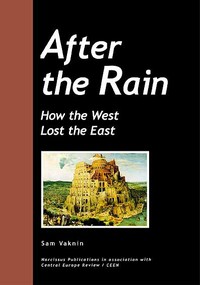
After the Rain : how the West lost the East — Background and Themes can be approached with a clearer sense of reading commitment from its source measurements: 87,215 words, 6 hr 20 min estimated reading time, and 10 detected text sections.
The text analysis averages about 17.3 words per sentence, while the detected sections provide another way to judge how the source is divided.
Project Gutenberg metadata also associates the work with “Europe, Eastern -- Politics and government -- 1989-,” connecting these edition facts with the source record’s subject description.
Explore this collection
These alternatives are selected using recorded categories and estimated reading time.
About 286 minutes
International Affairs
65,658 recorded words. 94 minutes difference from this book's estimate.
View Gutenberg source #75469About 275 minutes
International Affairs
63,224 recorded words. 105 minutes difference from this book's estimate.
View Gutenberg source #56379About 206 minutes
International Affairs
47,333 recorded words. 174 minutes difference from this book's estimate.
View Gutenberg source #6358Search stored excerpts and compare books → Choose by your preferences →
Choices use stored catalog measurements. Estimates vary with reading speed. A shared category is a catalog label, not a claim that two books have the same argument or literary quality.
Search reads excerpt text stored with this catalog and links to its associated Gutenberg record. The connection is stored in the site database; this tool does not recheck that every excerpt is word-for-word identical to that external record. Excerpt search does not cover every chapter and does not verify historical publication dates.
Catalog snapshot checked: 2026-09-25. Coverage: 90 public books, 90 available source excerpts.
Read the complete public-domain text at its original source.
Read on Project GutenbergSamuel Vaknin's After the Rain: How the West Lost the East opens with a table of contents that reads like a polemical index: 'The Author of this Article is a Racist,' 'The Cavemen and the Alien,' 'Rasputin in Transition.' These headings signal a combative, aphoristic style that pervades the excerpts. Vaknin favors vivid, often caustic metaphors—NATO is 'an elephant' in a 'China shop,' the EU dangles a 'cornucopian promise'—and his syntax frequently piles clauses into long, breathless sentences. The editorial note below traces three authorial choices visible in the provided text: the use of animal imagery to characterize geopolitical actors, the structural repetition of tripartite geographic divisions, and the deployment of ironic or sarcastic register in describing institutional behavior.
Vaknin repeatedly reduces nations and alliances to animal figures, a device that sharpens his critique while risking oversimplification. The United States is 'too much of an elephant' in Europe's 'China shop,' implying clumsy destructiveness. NATO becomes 'the introverted giant' that wakes up 'hyperactive and violent,' a bear-like transformation. The 'fighting goons' and 'battle-shy, logistics-only allies' recast member states as a pack with distinct roles. This bestiary extends to the Balkans: the region is a 'bleeding, limb-torn statal rump,' evoking a wounded beast. The effect is to render abstract power relations as visceral, almost fable-like conflicts. Yet the metaphors also flatten nuance—the 'elephant' America is never given internal complexity, and the 'goons' reduce military contributions to caricature. Vaknin's diction here prioritizes rhetorical impact over analytical balance, a choice consistent with the book's polemical framing.
The excerpt organizes its critique into three geographic subsections—'a. The Americans,' 'b. Central Europe,' 'c. The Balkan Sore'—a pattern that recurs throughout the table of contents (e.g., 'The People,' 'The Economy,' 'The Future'). This tripartite division imposes order on a sprawling subject, but it also creates a rhetorical rhythm: each section escalates the indictment. In 'The Americans,' Vaknin lambasts Washington's 'detached, callous and off-handed manner'; in 'Central Europe,' he describes 'the rudest awakening imaginable'; in 'The Balkan Sore,' the EU's 'verbal pyrotechnics' are a 'brainwashing' campaign. The structure allows him to move from global to regional to local, tightening the focus. However, the subsections are not equally developed—the Balkan section is notably shorter and more metaphorical—suggesting that the tripartite form serves argumentative momentum as much as comprehensive coverage. Readers should note how this scaffolding shapes the book's persuasive arc.
Vaknin's tone frequently shifts into irony, especially when describing Western institutions. The EU's promises are 'enticing vision' and 'great spinning and marketing techniques'; its reports on Central Europe are 'sadistic' and 'gleefully presented.' NATO's transformation is 'not a seemly sight.' This ironic register undercuts the official narratives of benevolent intervention and democratic transition. The phrase 'avuncularly benevolent umbrella' drips with sarcasm, framing American protection as patronizing. Similarly, 'the amateurs in Washington' dismisses expertise with casual contempt. The irony is not merely stylistic; it functions as a rhetorical weapon, aligning the reader with Vaknin's skepticism. Yet the excerpts offer no counter-evidence or alternative data—the irony stands alone as a judgment. This choice privileges voice over verification, making the book a sustained polemic rather than a dispassionate analysis. Readers should weigh the effectiveness of this register against the absence of corroborating sources in the provided text.
Vaknin's vocabulary draws heavily on physical and medical imagery: 'bleeding, limb-torn statal rumps,' 'bruising internal verbal fistfights,' 'shock waves,' 'reverberate.' The Balkans are a 'sore,' the EU's promises a 'brainwashing.' This diction frames political transition as a bodily crisis—wounds, convulsions, infections. The effect is to make abstract processes (EU enlargement, NATO strategy) feel immediate and painful. The repeated use of 'rude awakening,' 'shattered,' and 'humiliating' reinforces a sense of trauma. Notably, the excerpts avoid economic or statistical language; the crisis is rendered through sensation, not data. This choice aligns with the book's subtitle—'How the West Lost the East'—which implies a moral and emotional failure rather than a policy error. Readers should consider how this somatic lexicon shapes the book's argument: it invites empathy for the 'bleeding' East while casting the West as a detached, even sadistic, physician.
The excerpts from After the Rain reveal a writer who wields metaphor, structure, and tone as instruments of indictment. Vaknin's animal imagery, tripartite organization, ironic register, and bodily diction collectively construct a narrative of betrayal and trauma. Readers should approach the book as a polemic that prioritizes rhetorical force over empirical balance; its value lies in the vividness of its critique rather than in dispassionate analysis. The absence of counterarguments or data in the provided text suggests that the full work may sustain this combative voice across its 87,000 words, making it a document of a particular historical moment's anger and disillusionment.
Reading the editor’s notes on Vaknin’s clipped, weary dialogue, I kept thinking about how loneliness sounds different in each language. His Eastern Europe feels like a room after the guests leave. That same quiet ache lingers in Uncle Sam Abroad — Context and Discussion, where Western certainty meets the same hollow echoes. Strange, how empires whisper the same goodbye.
Your answers remain private and are stored only in this browser.