
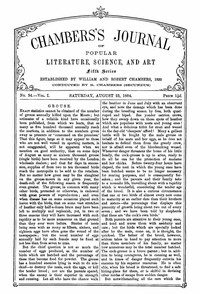
Chambers's Journal of Popular Literature, Science, and Art, Fifth Series, No.…
Let's be clear: this isn't a novel. Chambers's Journal is a time capsule, a weekly magazine from the 1880s bound into a single volume. There's no single story. Instead, you get a front-row seat to the conversations of an entire era. One moment you're following a serialized adventure story about explorers in Africa, full of danger and unknown lands. The next, you're reading a factual report on the latest advances in photography or public health.
The Story
Think of it like the best podcast feed or magazine rack you can imagine, but from 140 years ago. The 'plot' is the unfolding of a week in the life of the curious Victorian mind. It jumps from fiction to science to art to gossip without warning. You might get a poignant short story about a lost love, immediately followed by a detailed guide on household economy or a debate about education reform. The tension comes from seeing a society in motion, grappling with massive change while still telling each other ghost stories by the fire.
Why You Should Read It
I loved this because it destroys stereotypes. The Victorians weren't just stiff and proper; they were fascinated, confused, and excited by their rapidly changing world. Reading their journal is surprisingly intimate. You see their sense of humor, their fears (there are a lot of eerie tales), and their genuine awe at things we take for granted, like the telephone. The writing is direct and clear, meant to inform and entertain a broad audience. It's not stuffy. It feels alive.
Final Verdict
This is perfect for history lovers who want to go beyond dry facts, for short story fans who enjoy variety, and for anyone with a curious mind. It's a book to dip into, not binge. Read a few pieces at a time and let the strange, wonderful atmosphere of the 1880s sink in. If you like the idea of literary channel-surfing through the past, you'll find this collection absolutely captivating.
This historical work is free of copyright protections. It serves as a testament to our shared literary heritage.
Mary Hernandez
6 months agoThe analytical framework presented is both innovative and robust.
William Lee
7 months agoClear, concise, and incredibly informative.
George Wilson
2 months agoI decided to give this a try based on a colleague's recommendation, the wealth of information provided exceeds the average market standard. Simple, effective, and authoritative – what else could you ask for?
Mary Hernandez
11 months agoWhile browsing through various academic sources, the bibliography and references suggest a high level of research and authority. I am looking forward to the author's next publication.






Michael Rodriguez
8 months agoUnlike many other resources I've purchased before, the narrative arc keeps the reader engaged while delivering factual content. It definitely lives up to the reputation of the publisher.