
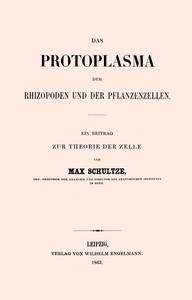
Das Protoplasma der Rhizopoden und der Pflanzenzellen by Max Schultze
Let's set the scene: it's the mid-1800s. Scientists are peering into microscopes, drawing what they see, and trying to make sense of a hidden world. They know about cells, but what exactly is a cell? Is it the wall? The little kernel inside? Max Schultze steps in and says, 'Hold on. The important part is the living jelly inside.'
The Story
This isn't a story with characters in the usual sense. The 'characters' are amoebas (rhizopods) and plant cells. Schultze's plot is his meticulous investigation. He compares them side-by-side, detail by detail. He shows how both are essentially little bags of the same viscous, flowing substance—protoplasm. He argues that this substance, not the cell wall, is the essential unit of life. The 'conflict' is his idea against the established view. The 'mystery' is: what is life made of? And his conclusion is elegant and radical: at its core, all life shares the same physical foundation.
Why You Should Read It
You read this not for a gripping narrative, but for the thrill of the 'aha!' moment. It's humbling. Schultze connects a creeping amoeba to a blade of grass through sheer observation and logic. In today's world of genetic code and molecular machinery, it's easy to forget that someone had to first point at the basic 'stuff' and give it a name. Reading his work feels raw and immediate. You're right there with him, looking at the drawings and following his train of thought as he builds a foundational idea of modern biology.
Final Verdict
This is a niche pick, but a fascinating one. It's perfect for science history fans, biology students who want to see where key concepts began, or any curious reader who enjoys seeing how big ideas are born from simple, careful observation. It's not a beach read, but as a look into the moment scientists started to see the unity of all life, it's pretty powerful.
This text is dedicated to the public domain. Share knowledge freely with the world.
Andrew White
1 year agoFrom the very first page, the clarity of the writing makes this accessible. Exactly what I needed.
Michael Torres
1 year agoThe index links actually work, which is rare!
Edward Walker
2 years agoFinally found time to read this!
Noah Lee
1 year agoFrom the very first page, the author's voice is distinct and makes complex topics easy to digest. This story will stay with me.


Barbara Flores
1 year agoThis is one of those stories where the clarity of the writing makes this accessible. I couldn't put it down.