
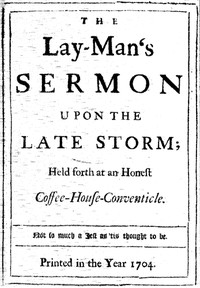
The Lay-Man's Sermon upon the Late Storm by Daniel Defoe
Okay, let's set the scene. It's November 1703, and one of the worst storms in British history hits London. The Great Storm. It was chaos—chimneys toppled, the lead roof of Westminster Abbey rolled up like paper, and over 8,000 people died at sea. In the stunned aftermath, a young Daniel Defoe (yes, that Defoe) did what he did best: he hit the streets and started asking questions.
The Story
This isn't a novel with a plot. It's more like a journalist's notebook mixed with a fiery public speech. Defoe first makes sure we understand the sheer scale of the destruction. He tells us about specific ships lost, buildings wrecked, and the widespread fear. Then, he gets to the heart of it. Everyone was asking if the storm was a sign from God, a judgment on the nation. Defoe takes that public anxiety and runs with it. He argues that yes, it was a warning, but not for the reasons some angry preachers claimed. He says it's a call for personal reflection and national unity, not a reason to point fingers. He's trying to guide a terrified public toward a constructive response, using the shared trauma of the storm as his pulpit.
Why You Should Read It
What grabbed me was the energy. You can feel Defoe's mind working. He's not a distant historian; he's a reporter and a commentator in the middle of the mess. You see the early spark of the writer who would later create a whole world for Robinson Crusoe. Here, his world is real, and it's broken. Reading this is like finding a time capsule. It shows you how people without modern science explained natural disasters, and how a clever writer used current events to talk about morality, society, and faith. It's Defoe without the fiction, all passion and persuasion.
Final Verdict
This is a niche read, but a fascinating one. It's perfect for history buffs who want to feel the grit of everyday life in the 1700s, or for Defoe fans curious about his early work. If you enjoy primary sources—real voices from the past—this is a short, powerful hit. It's not a beach read, but for a quick, immersive trip into a moment of public panic and one man's attempt to make sense of it, it's absolutely gripping.
This digital edition is based on a public domain text. Access is open to everyone around the world.
Joseph Miller
10 months agoOne of the most comprehensive guides I've read this year.
Joseph Hernandez
11 months agoOne of the most comprehensive guides I've read this year.
Margaret Miller
4 months agoI was skeptical about the depth of this book at first, but the way it challenges the status quo is both daring and well-supported. A solid investment for anyone's personal development.
Edward Nguyen
1 year agoPerfect.






Donald Garcia
6 months agoThis was exactly the kind of deep dive I was searching for, the author manages to bridge the gap between theory and practice effectively. I appreciate the effort that went into this curation.