About 29 minutes
Arkansas Governors and United States Senators — A Closer Reading
Government
6,586 recorded words. 6 minutes difference from this book's estimate.
View Gutenberg source #17433
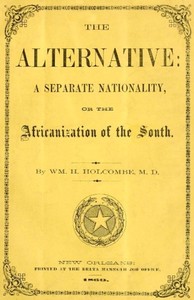
For The Alternative: A Separate Nationality; or, The Africanization of the South — Text and Context, the stored edition analysis reports 7,982 words, 35 min estimated reading time, and 1 detected text section.
The text analysis averages about 23.7 words per sentence, while the detected sections provide another way to judge how the source is divided.
Project Gutenberg metadata also associates the work with “Slavery -- United States,” connecting these edition facts with the source record’s subject description.
Explore this collection
These alternatives are selected using recorded categories and estimated reading time.
About 29 minutes
Government
6,586 recorded words. 6 minutes difference from this book's estimate.
View Gutenberg source #17433About 62 minutes
Government
14,185 recorded words. 27 minutes difference from this book's estimate.
View Gutenberg source #10805About 63 minutes
Government
14,490 recorded words. 28 minutes difference from this book's estimate.
View Gutenberg source #5035Search stored excerpts and compare books → Choose by your preferences →
Choices use stored catalog measurements. Estimates vary with reading speed. A shared category is a catalog label, not a claim that two books have the same argument or literary quality.
Search reads excerpt text stored with this catalog and links to its associated Gutenberg record. The connection is stored in the site database; this tool does not recheck that every excerpt is word-for-word identical to that external record. Excerpt search does not cover every chapter and does not verify historical publication dates.
Catalog snapshot checked: 2026-09-25. Coverage: 90 public books, 90 available source excerpts.
Read the complete public-domain text at its original source.
Read on Project GutenbergWilliam H. Holcombe’s 1860 pamphlet opens with a stark binary: “submission or secession.” The title itself—The Alternative: A Separate Nationality; or, The Africanization of the South—frames the choice as one between political independence and a feared racial transformation. Holcombe wastes no time in declaring that the sectional conflict is not about territories or Supreme Court decisions but a “total reversion of public opinion” on slavery over the preceding quarter-century. His voice is declarative and urgent, building a case through sharp contrasts: the North’s “fanaticism” versus the South’s unanimity, Garrison dragged through Boston streets versus the same city now applauding John Brown. The pamphlet’s pace accelerates as it moves from diagnosis to demand, culminating in a call for the Cotton States to lead a separate confederacy.
Holcombe’s argument rests on the claim that the division between North and South is “broader and deeper and more incurable” than any political compromise. He dismisses the idea that new lines or compacts could arrest the danger, insisting instead that the antagonism is “fundamental and ineradicable.” This language of incurability recurs throughout the pamphlet, reinforcing a sense of inevitable rupture. Notably, Holcombe does not engage in legalistic debate over states’ rights or constitutional interpretation; he grounds the conflict in a moral and racial absolutism. The North’s “total reversion of public opinion” is presented as a fact beyond analysis—he declines to examine its causes, calling it “one of the strangest chapters of history.” This rhetorical move allows him to bypass nuance and present secession as the only logical response to an unbridgeable divide.
The pamphlet’s structure mirrors its argument: a rapid accumulation of grievances leads to a climactic demand for action. Holcombe begins with a historical contrast (Garrison’s rope vs. Fanueil Hall’s applause), then shifts to a present-tense indictment of the Republican party as a “usurpation.” The pace quickens through a series of short, emphatic clauses: “The question is at length plainly presented”; “The time for our separation has come.” By the final pages, the prose becomes hortatory, calling on the Cotton States to move first and pledging “lives and fortunes” to defend the border. This acceleration from diagnosis to exhortation mirrors the pamphlet’s political purpose: to transform readers from passive observers into active participants in secession. The urgency is further heightened by Holcombe’s repeated use of “now” and “at length,” creating a sense that delay is impossible.
Holcombe adopts the voice of a collective Southern spokesman, using “we” and “our” to align himself with his audience. He asserts that “there is no man in the South so stupid, so cowardly, so base as to be willing to live in the Union as it is,” a claim that erases dissent and presents a unified regional identity. This persona is both defensive and aggressive: he dismisses abolitionists as a “motley crew of men who should be women and of women who should be men,” while simultaneously positioning Southern slaveholders as “loving friends, chivalrous enemies and good masters” entrusted by God with the care of “his most helpless and degraded children.” The voice oscillates between legalistic grievance (“outraged our feelings, violated our rights”) and providential rhetoric (“the evolution of history, according to the laws of Providence”). This blend of indignation and divine mandate gives the pamphlet a prophetic tone, as if Holcombe is not merely arguing but announcing an inevitable destiny.
Holcombe’s pamphlet is best read as a specimen of secessionist rhetoric at a specific historical moment—the months following Lincoln’s election but before the outbreak of war. Its value lies not in originality of argument but in the intensity and compression of its language. Readers should attend to how Holcombe constructs a sense of inevitability through pace and voice, and how he frames the conflict as a moral and racial absolute rather than a political negotiation. The pamphlet’s brevity (under 8,000 words) makes it a concentrated example of the rhetorical strategies that preceded disunion.
Reading this pamphlet’s desperate certainty, I remember sitting in my grandfather’s study, tracing the margins of an old congressional debate digest, feeling the same weight of voices arguing toward a precipice they couldn’t see. His pencil notes felt like whispers. That Abridgment of the Debates of Congress, from 1789 to 1856, Vol. 3 (of 16) — Context and Discussion held the same breathless before-storm calm, as if history itself was holding its breath.
Use these questions to collect your thoughts before moving on.









