About 3,301 minutes
Abridgment of the Debates of Congress, from 1789 to 1856, Vol. 2 (of 16) — Text and Context
Government
759,190 recorded words. 33 minutes difference from this book's estimate.
View Gutenberg source #40851
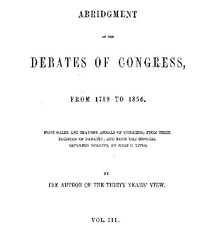
Before opening Abridgment of the Debates of Congress, from 1789 to 1856, Vol. 3 (of 16) — Context and Discussion, the edition data offers a quick orientation: 751,591 words, 54 hr 28 min estimated reading time, and 72 detected text sections.
The text analysis averages about 26.2 words per sentence, while the detected sections provide another way to judge how the source is divided.
Project Gutenberg metadata also associates the work with “United States -- Politics and government,” connecting these edition facts with the source record’s subject description.
Explore this collection
These alternatives are selected using recorded categories and estimated reading time.
About 3,301 minutes
Government
759,190 recorded words. 33 minutes difference from this book's estimate.
View Gutenberg source #40851About 3,335 minutes
Government
766,967 recorded words. 67 minutes difference from this book's estimate.
View Gutenberg source #47289About 3,441 minutes
Government
791,406 recorded words. 173 minutes difference from this book's estimate.
View Gutenberg source #40499Search stored excerpts and compare books → Choose by your preferences →
Choices use stored catalog measurements. Estimates vary with reading speed. A shared category is a catalog label, not a claim that two books have the same argument or literary quality.
Search reads excerpt text stored with this catalog and links to its associated Gutenberg record. The connection is stored in the site database; this tool does not recheck that every excerpt is word-for-word identical to that external record. Excerpt search does not cover every chapter and does not verify historical publication dates.
Catalog snapshot checked: 2026-09-25. Coverage: 90 public books, 90 available source excerpts.
Read the complete public-domain text at its original source.
Read on Project GutenbergThomas Hart Benton's Abridgment of the Debates of Congress, Volume 3, compresses the proceedings of the Eighth Congress (1803–1805) into a single narrative, filtering the sprawling Annals of Congress and Register of Debates through an editor's hand. The volume opens with the Senate's roll call on October 17, 1803, listing thirty-two members from seventeen states, including Ohio's first senators. Benton's method is visible in the brisk transitions: a resolution on impressment moves from Mr. Elliot's florid appeal—"the groans of our impressed fellow-citizens mingle with the murmurs of every gale"—to unanimous adoption within a single paragraph. The abridgment preserves the cadence of spoken argument while stripping away procedural repetition, creating a compressed record that foregrounds the most charged exchanges.
The excerpts reveal a striking contrast between rhetorical intensity and procedural brevity. Mr. Elliot's speech on impressment employs elaborate metaphor—"the queen of that element ought no longer to be suffered to bespangle her diadem with the tears of American seamen"—yet the resolution passes immediately. Benton's abridgment preserves the full emotional arc of such speeches while excising the routine motions that followed. This compression highlights how early Congress members used the floor for public persuasion, not just legislative mechanics. The editor's choices emphasize moments where language itself becomes a political act, as when Elliot demands that Congress "take an attitude worthy of the nation." The reader witnesses oratory as a tool for shaping national identity, even when the actual legislative outcome is a single unanimous vote.
A brief entry for January 14, 1804, records that the House "commenced their proceedings this morning, at eleven o'clock, in secret sitting." The session lasted until three o'clock, when "the doors were opened, and an adjournment ensued." No debate is transcribed; the abridgment offers only the fact of secrecy. This lacuna is itself revealing: Benton's source material likely contained no record of the confidential business, and the editor chose not to speculate. The passage underscores the limits of the abridgment—it can only report what was publicly spoken. The shift from open debate to closed doors, and back, marks a change in the tempo of governance, from the measured oratory of the impressment debate to the opaque urgency of confidential matters. The reader is left to infer the gravity of the business from the altered schedule alone.
On January 17, 1804, a memorial from the Indiana Territory was presented, suggesting "the expediency of a division of the Indiana Territory, and the erection into a separate Territorial government of a part thereof; of the formation of a Western State; of the admission of slavery into the said Territory." The petition's language is direct and practical, lacking the oratorical flourishes of the impressment debate. Benton's abridgment presents it as a list of requests, not a speech. This contrast in register—between the polished rhetoric of eastern congressmen and the utilitarian petitions from the frontier—reveals the diverse voices entering the national conversation. The editor's decision to include the full list of suggestions, rather than summarizing, preserves the petitioners' own priorities. The slavery question is introduced without editorial comment, left to stand as a raw demand from the territory.
Benton's abridgment offers a unique vantage on early congressional history: it is neither a transcript nor a history, but a curated selection that emphasizes moments of rhetorical and procedural significance. Readers should attend to what is omitted—the routine business, the unrecorded secret sessions—as much as what is preserved. The volume's value lies in its compression, which forces the reader to consider why certain speeches and petitions were deemed worth saving, and what their juxtaposition reveals about the priorities of the early republic.
Sitting with these old congressional debates, I recall my grandfather’s hushed stories about land and legacy. The way those frontier voices wrestled with territory and freedom felt familiar—it reminded me of Arkansas Governors and United States Senators — A Closer Reading, which once stirred the same quiet awe. Both books feel like eavesdropping on history’s uncertain heartbeat.
A brief reflection can help important ideas stay with you longer.









