
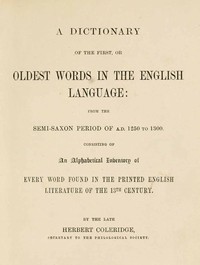
A Dictionary of the First or Oldest Words in the English Language by Coleridge
Let's be clear from the start: this isn't a novel. You won't find a plot with heroes and villains. Instead, think of it as an archaeological dig for words. Herbert Coleridge, the grandson of the famous poet Samuel Taylor Coleridge, set out on a monumental task. He wanted to create a complete historical dictionary of the English language. This book, published after his tragically early death at age 30, is a piece of that unfinished project. It's a simple list—an alphabetical catalog of the oldest words found in English texts up to his time, often with their earliest known source and meaning.
The Story
The 'story' is the journey of the language. Coleridge and his team sifted through ancient manuscripts, charters, and poems, hunting for the first written appearance of each word. Each entry is a tiny snapshot. You might look up 'child' and find its Old English ancestor, 'cild,' cited from a law code written over a millennium ago. You see words that are instantly recognizable ('hand,' 'sun'), words that look like typos ('hus' for house), and words that are utterly foreign to us now, lost to history. The book itself is the record of this search, a foundation stone for the monumental Oxford English Dictionary that would come later.
Why You Should Read It
Reading this is a strangely personal experience. It connects you directly to the raw material of thought. You realize that every conversation you have is built on these ancient, weathered bricks. There's a quiet thrill in seeing the word 'friend' come from the Old English 'freond,' or discovering that 'awful' once literally meant 'full of awe' (in a good way!). It makes you appreciate the sheer durability of some ideas and the fragility of others. It's less about memorizing facts and more about feeling the weight and age of the tools you use to think and communicate every day.
Final Verdict
This is a book for the curious and the patient. It's perfect for word lovers, history enthusiasts, writers looking for depth, or anyone who enjoys getting lost in a reference book with a great concept. Don't sit down to read it cover-to-cover. Instead, keep it on your shelf or as a digital file. Dip into it now and then. Look up a common word and meet its ancient ancestor. It's a quiet, profound reminder that the English language is a living museum, and we are all curators, adding new exhibits every time we speak.
This text is dedicated to the public domain. Distribute this work to help spread literacy.
Margaret Williams
8 months agoCitation worthy content.
Jennifer Robinson
1 year agoSimply put, it provides a comprehensive overview perfect for everyone. Thanks for sharing this review.
Aiden Scott
4 months agoThanks for the recommendation.



Jessica Martin
1 year agoAfter finishing this book, it provides a comprehensive overview perfect for everyone. Definitely a 5-star read.