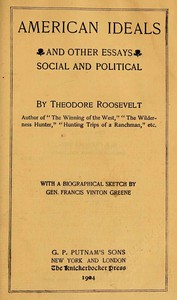
Theodore Roosevelt's American Ideals, and Other Essays, Social and Political opens not with his own words but with a biographical sketch by General Francis Vinton Greene, who presents Roosevelt as a figure known chiefly for his Rough Rider exploits, yet insists his career is far more varied. Greene traces Roosevelt's Dutch and Southern ancestry, his sickly childhood, and his rapid rise from Harvard to the New York State Legislature, where he 'plunged at once into the thick of the fight as an ardent reformer.' This framing establishes a pattern: the collection will foreground action, conflict, and moral purpose.
The first essay proper, 'American Ideals,' likely sets the tone for the volume, though the excerpts provided jump to later pieces on police reform and the vice-presidency. Readers should note how Roosevelt's voice—direct, combative, and self-assured—carries through diverse topics, from municipal corruption to constitutional theory.
The Biographical Frame and Roosevelt's Voice
Greene's sketch, written in 1897, emphasizes Roosevelt's 'earnestness and aggressive energy' and his legislative record as a reformer. The sketch is not neutral; it primes the reader to see Roosevelt as a man of action who 'introduced and carried through more important city legislation than was ever brought about by any one assemblyman.' This is a partisan portrait, but it usefully orients the reader to the essays that follow. Roosevelt's own prose, glimpsed in the police reform excerpt, matches this energy: he writes of 'the venemous opposition of all men whose interest it was that corruption should continue,' using italics for emphasis and a blunt moral vocabulary. The reader should watch for this pattern—Roosevelt rarely hedges; he names enemies and allies plainly.
Police Reform as a Case Study in Administration
In the excerpt on police reform, Roosevelt describes his tenure on the Police Board, claiming he and his colleague 'enforced the laws as they were on the statute books, we broke up blackmail, we kept down the spirit of disorder, and repressed rascality.' The passage is notable for its self-certainty: Roosevelt presents reform as a straightforward battle between honesty and corruption, with himself on the side of the angels. He acknowledges attacks from 'every sensational newspaper and every politician of the baser sort,' but dismisses criticism as motivated by self-interest. This section gives the reader a concrete example of Roosevelt's administrative philosophy—one that prizes enforcement, order, and moral clarity over compromise. It also reveals his tendency to frame political struggle as a personal vendetta against vice.
Constitutional Analysis: The Vice-Presidency
The essay on the vice-presidency shifts from municipal detail to constitutional theory. Roosevelt calls the vice-president 'an officer unique in his character and functions, or to speak more properly, in his want of functions,' and compares the position to a monarchical heir apparent. He traces the founders' intentions, noting that they 'distrusted what would now be called pure Democracy, and they dreaded what we would now call party government.' The essay is historically grounded, referencing the Adams-Jefferson administration as an example of the original electoral system's flaws. Roosevelt's analysis is clear and opinionated, but it lacks the personal animus of the police reform piece. Readers should note how Roosevelt adapts his tone to the subject: here he is the learned commentator, not the embattled reformer.
Roosevelt's Rhetorical Strategies Across Essays
Across the excerpts, Roosevelt employs several consistent rhetorical moves. He uses italics for emphasis, as when he writes that the founders 'builded very wisely of set purpose' or that the vice-president's importance lies in 'his possibility of at any moment ceasing to be a functionless official.' He also relies on contrast: the vice-president's 'want of functions' versus his potential power; the reformers' honesty versus the 'baser sort' of politicians. His sentences are often long and periodic, building to a pointed conclusion. The reader should attend to how Roosevelt balances personal narrative with abstract argument—the police essay is autobiographical, the vice-presidency essay historical. This variety suggests a collection that moves between memoir and policy, held together by a consistent authorial voice.
The excerpts from American Ideals reveal a writer who treats politics as a moral arena and himself as an instrument of reform. Readers new to Roosevelt's prose should expect directness, self-assurance, and a willingness to name opponents. The collection's range—from municipal administration to constitutional theory—reflects Roosevelt's own varied career. Approach these essays not as systematic philosophy but as the arguments of a man who believed that 'honesty and efficiency' could be combined, and who was eager to prove it.
There’s something steadying in Roosevelt’s insistence that governance is about character, not just machinery. It reminds me of an older, quieter book, American Political Ideas Viewed from the Standpoint of Universal History — Story, Setting & Ideas, where those same convictions feel less like battle cries and more like inherited wisdom. Both leave me with a lingering fondness for what we meant to become.