About 70 minutes
Experiments in Government and the Essentials of the Constitution — Key Ideas to Explore
Political Thought
15,950 recorded words. 28 minutes difference from this book's estimate.
View Gutenberg source #10485
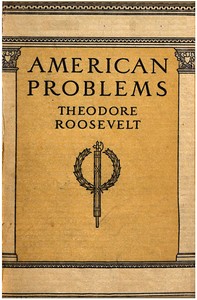
For American problems — Reading Notes, the stored edition analysis reports 22,359 words, 1 hr 38 min estimated reading time, and 9 detected text sections.
The text analysis averages about 32.9 words per sentence, while the detected sections provide another way to judge how the source is divided.
Project Gutenberg metadata also associates the work with “United States -- Politics and government,” connecting these edition facts with the source record’s subject description.
Explore this collection
These alternatives are selected using recorded categories and estimated reading time.
About 70 minutes
Political Thought
15,950 recorded words. 28 minutes difference from this book's estimate.
View Gutenberg source #10485About 133 minutes
Political Thought
30,460 recorded words. 35 minutes difference from this book's estimate.
View Gutenberg source #74319About 156 minutes
Political Thought
35,693 recorded words. 58 minutes difference from this book's estimate.
View Gutenberg source #10112Search stored excerpts and compare books → Choose by your preferences →
Choices use stored catalog measurements. Estimates vary with reading speed. A shared category is a catalog label, not a claim that two books have the same argument or literary quality.
Search reads excerpt text stored with this catalog and links to its associated Gutenberg record. The connection is stored in the site database; this tool does not recheck that every excerpt is word-for-word identical to that external record. Excerpt search does not cover every chapter and does not verify historical publication dates.
Catalog snapshot checked: 2026-09-25. Coverage: 90 public books, 90 available source excerpts.
Read the complete public-domain text at its original source.
Read on Project GutenbergTheodore Roosevelt's American Problems, a 1910 collection of essays originally published in The Outlook, opens with a pointed distinction between small states capable of self-government and those that are not. In the first chapter, Roosevelt argues that guaranteeing the borders of a state like Switzerland is sufficient, whereas a community unable to maintain order or justice may be harmed by such a guarantee—a position that frames his subsequent arguments about American responsibilities abroad and at home.
The excerpts show a writer who moves between concrete policy examples and broad principles, often using contrast as a rhetorical device. The later passages on economic power shift the focus inward, warning against both the concentration of wealth and the impulse toward vindictive regulation. Roosevelt insists on a cautious, experimental approach to expanding government activity, always tethered to the goal of improving the average citizen's welfare without crushing exceptional individuals.
The first chapter, “The Management of Small States Which Are Unable to Manage Themselves,” establishes a key distinction that recurs throughout the book. Roosevelt contrasts a state like Switzerland—which differs from great nations only in size and is fully capable of preserving order and justice—with a community that cannot secure elementary order or protect foreign rights. For the former, an international guarantee against aggression suffices; for the latter, such a guarantee may be the worst possible outcome, as it prevents the intervention needed to establish stability.
This argument is built on a specific example: a letter from an Anti-Imperialist correspondent who proposed international agreements to protect Egypt and the Philippines. Roosevelt rejects the analogy, insisting that the two classes of cases are “totally different.” The reasoning is grounded in a pragmatic assessment of a state's internal capacity, not in abstract principles of sovereignty. Readers should note how this opening framework sets the stage for Roosevelt's later discussions of American power and responsibility.
In a later excerpt, Roosevelt turns from foreign affairs to domestic economic policy, arguing that the “unlimited freedom” of property owners has produced “evils which were inevitable from its unrestrained exercise.” He identifies a small class of enormously wealthy men whose power is not necessarily the result of cheating, but of a system that allows accumulation without regard for the general welfare. Roosevelt is careful to avoid demonizing individuals: “big men are no better and no worse than their small competitors, from a moral standpoint.”
The problem, he insists, is structural. The goal is to change the conditions that enable such concentration, not to punish the wealthy out of vindictiveness. He advocates for “the minimum of restrictions upon the individual initiative of the exceptional man which is compatible with obtaining the maximum of welfare for the average man.” This balancing act—between curbing excess and preserving incentive—is a central tension in the book, and Roosevelt returns to it repeatedly, always emphasizing caution and experimentation.
Roosevelt explicitly acknowledges that his proposals imply “a policy of a far more active governmental interference with social and economic conditions than we have hitherto seen in this country.” He presents this not as a radical departure but as a necessary evolution of democratic governance. The purpose is to make popular government “responsible for the betterment both of the individual and of society at large.”
Yet he immediately qualifies this by insisting that governmental action must be accompanied by individual effort toward “a higher standard of individual betterment, not merely material but spiritual and intellectual.” The two are interdependent: collective action cannot succeed without personal responsibility, and individual improvement alone cannot remedy systemic problems. This dual emphasis—on structural reform and personal character—is a hallmark of Roosevelt's political thought, and it shapes the rhetorical structure of the essays, which often move from policy analysis to moral exhortation.
Across the excerpts, Roosevelt employs several consistent rhetorical techniques. He frequently uses contrast, as in the opening distinction between types of small states and later between the morality of big and small businessmen. He also relies on concession and qualification: acknowledging the value of individual freedom before arguing for its limits, or praising the achievements of industrial leaders before warning of their power. This pattern gives his arguments a measured, judicious tone, even when advocating for significant change.
The structure of the essays is similarly deliberate. Each begins with a specific case or problem, moves to a general principle, and then applies that principle to American conditions. The prose is direct and declarative, with frequent use of the first-person plural (“we must face the fact,” “we should work cautiously”). Readers should pay attention to how Roosevelt builds his case step by step, often anticipating objections and addressing them before they are fully stated. This methodical approach reflects his background as both a politician and a writer for a weekly magazine.
Reading American Problems as a collection of occasional pieces rather than a unified treatise helps explain its shifts in focus and tone. The excerpts suggest that Roosevelt is less concerned with constructing a systematic philosophy than with persuading his audience on specific issues of the day. Pay attention to the dates of original publication (1910, after his return from Africa) and the context of the Progressive Era. The book rewards readers who follow the interplay between principle and pragmatism, and who note how Roosevelt's arguments for intervention abroad parallel his arguments for regulation at home.
Reading Roosevelt’s insistence on hard limits to governance, I remembered sitting with my grandfather, who quoted old civic lessons while the porch light flickered. That same patient tension—between liberty and restraint—surfaced again in American Political Ideas Viewed from the Standpoint of Universal History — Story, Setting & Ideas, where the weight of responsibility felt almost familial, a quiet echo rather than a lecture.
Capture what you thought, learned, and would like to remember.