About 161 minutes
Practical Agitation — Story, Setting & Ideas
Political Thought
36,986 recorded words. 92 minutes difference from this book's estimate.
View Gutenberg source #66610
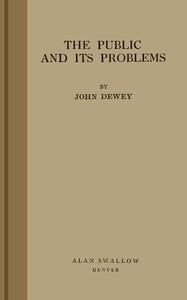
The catalog record for The public and its problems — Story, Setting & Ideas provides practical reading context through 58,076 words, 4 hr 13 min estimated reading time, and 12 detected text sections.
The text analysis averages about 23.2 words per sentence, while the detected sections provide another way to judge how the source is divided.
Project Gutenberg metadata also associates the work with “Democracy,” connecting these edition facts with the source record’s subject description.
Explore this collection
These alternatives are selected using recorded categories and estimated reading time.
About 161 minutes
Political Thought
36,986 recorded words. 92 minutes difference from this book's estimate.
View Gutenberg source #66610About 156 minutes
Political Thought
35,693 recorded words. 97 minutes difference from this book's estimate.
View Gutenberg source #10112About 133 minutes
Political Thought
30,460 recorded words. 120 minutes difference from this book's estimate.
View Gutenberg source #74319Search stored excerpts and compare books → Choose by your preferences →
Choices use stored catalog measurements. Estimates vary with reading speed. A shared category is a catalog label, not a claim that two books have the same argument or literary quality.
Search reads excerpt text stored with this catalog and links to its associated Gutenberg record. The connection is stored in the site database; this tool does not recheck that every excerpt is word-for-word identical to that external record. Excerpt search does not cover every chapter and does not verify historical publication dates.
Catalog snapshot checked: 2026-09-25. Coverage: 90 public books, 90 available source excerpts.
Read the complete public-domain text at its original source.
Read on Project GutenbergJohn Dewey opens The Public and Its Problems by distinguishing the public from the state, a move that sets the stage for his central argument: the public is not a fixed entity but a contingent phenomenon that emerges when the indirect consequences of transactions affect outsiders. Drawing on lectures delivered at Kenyon College in 1926, Dewey systematically critiques prevailing theories of the state—from those rooted in causal origin to those focused on perceived consequences—before proposing his own criterion: a public arises when the repercussions of private actions extend beyond the immediate parties, necessitating regulation by the state. This functional, experimental approach treats the state as a problem to be solved rather than a given institution.
Dewey contends that the public has become obscure and uncertain, eclipsed by the sheer scale and complexity of modern industrial society. He observes that local communities, once the bedrock of democratic participation, have been overwhelmed by national unification driven by technological factors. The result is a public that is “submerged” and “remote from government,” unable to identify itself or its interests. Dewey illustrates this with the rise of extra-legal agencies—political machines, parties, and business interests—that fill the void between citizens and their nominal representatives. He notes that parties now function less as creators of policy than as devices for preventing contentious issues from reaching the electorate, citing the fate of the Child Labor Amendment as a corroborating example.
Dewey takes aim at the doctrine of individualism that underpins classical liberal theory, arguing that it rests on a false antithesis between the natural and the artificial. He traces the historical origins of this doctrine to the influence of new industry and the theory of “natural” economic laws, but insists that wants and aims are functions of social life, not pre-social givens. The belief that individuals make choices in the privacy of their consciousness, he writes, is belied by the reality of citizens who merely vote for tickets made up by “an under-cover machine in a caucus whose operations constitute a kind of political predestination.” Dewey’s critique extends to the economic determinism implicit in the actions of both radical socialists and big business, each of whom treats material forces as the ultimate driver of politics.
Dewey confronts the tension between democratic governance and the growing reliance on expertise. He acknowledges that the complexity of modern society makes specialized knowledge indispensable, but warns against handing over political authority to experts. The problem, as he frames it, is not simply one of competence but of accountability: experts, left to their own devices, may serve their own interests or those of the powerful rather than the public good. Dewey insists that the public must remain the ultimate judge of policy, even if it lacks technical knowledge. This requires not only better education but also the cultivation of habits of inquiry and communication that can bridge the gap between experts and citizens. The challenge, he suggests, is to make expertise answerable to a public that is itself capable of forming intelligent judgments.
Dewey’s argument is not a prescription but a diagnosis, one that remains strikingly relevant to contemporary debates about democratic decline and the role of technology in politics. Readers should attend to his method: he treats the public as an empirical problem rather than an ideal, and his analysis of how indirect consequences generate political communities offers a framework for thinking about issues from climate change to digital privacy. The book rewards careful reading of its central distinction between private and public, and its insistence that democracy is not a fixed set of institutions but an ongoing experiment in collective problem-solving.
Reading Dewey again, I kept thinking how the old framers assumed a public that could still find itself. The distance between their optimism and our present quiet feels like a long, slow exhale. I came back to The Spirit of American Government A Study Of The Constitution: Its Origin, Influence And Relation To Democracy — A Reader’s Guide and wondered if we ever really had what Dewey hoped we might lose.
Create a short personal record of your experience with this book.