About 91 minutes
Open Source Democracy: How online communication is changing offline politics — Context and Discussion
Democracy Rights
20,763 recorded words. 39 minutes difference from this book's estimate.
View Gutenberg source #10753
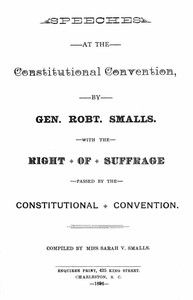
The catalog record for Speeches at the Constitutional Convention With the Right of Suffrage Passed by the Constitutional Convention — A Closer Reading provides practical reading context through 11,831 words, 52 min estimated reading time, and 8 detected text sections.
The text analysis averages about 26.4 words per sentence, while the detected sections provide another way to judge how the source is divided.
Project Gutenberg metadata also associates the work with “African Americans -- Suffrage,” connecting these edition facts with the source record’s subject description.
Explore this collection
These alternatives are selected using recorded categories and estimated reading time.
About 91 minutes
Democracy Rights
20,763 recorded words. 39 minutes difference from this book's estimate.
View Gutenberg source #10753About 241 minutes
Democracy Rights
55,243 recorded words. 189 minutes difference from this book's estimate.
View Gutenberg source #69959About 277 minutes
Democracy Rights
63,672 recorded words. 225 minutes difference from this book's estimate.
View Gutenberg source #15018Search stored excerpts and compare books → Choose by your preferences →
Choices use stored catalog measurements. Estimates vary with reading speed. A shared category is a catalog label, not a claim that two books have the same argument or literary quality.
Search reads excerpt text stored with this catalog and links to its associated Gutenberg record. The connection is stored in the site database; this tool does not recheck that every excerpt is word-for-word identical to that external record. Excerpt search does not cover every chapter and does not verify historical publication dates.
Catalog snapshot checked: 2026-09-25. Coverage: 90 public books, 90 available source excerpts.
Read the complete public-domain text at its original source.
Read on Project GutenbergThis pamphlet, compiled by Sarah V. Smalls in 1896, collects speeches her father, Robert Smalls, delivered during the 1895 South Carolina Constitutional Convention. The convention aimed to disfranchise Black voters, and Smalls, a former enslaved man who became a Union hero and congressman, was one of the few Black delegates. The compiler notes that no stenographers were employed, so the speeches are reproduced as they appeared in state newspapers, not in full. The excerpts show Smalls introducing a suffrage plan that would have barred racial distinctions, and later moving an amendment to prohibit illicit interracial cohabitation alongside legal intermarriage—a tactical response to a white delegate's proposal. The record also includes his refusal to sign the final constitution and editorials praising his parliamentary skill.
Smalls introduced a suffrage plan that began: “Every male citizen of the United States of the age of twenty-one years and upwards, not laboring under the disabilities named in this Constitution, without distinction of race, color or former condition…” The plan required one year's residence in the state and sixty days in the county. It was referred to committee, reported unfavorably, and ultimately rejected. The excerpts do not show the full debate, but the plan's language directly countered the convention's stated goal of disfranchising Black voters. Smalls's proposal would have preserved the voting rights established after the Civil War, making no mention of literacy tests, property requirements, or other mechanisms used to restrict Black suffrage in the final constitution.
When a white delegate introduced a section to prohibit interracial marriage, Smalls moved an amendment to also prohibit illicit cohabitation between the races. He argued: “I oppose the intermarriage of the races as strongly as you do… But sir, don’t tell me that you will make a law to prevent lawful marriages and give full license to illicit marriages.” He pointed to census data showing the practice decreasing among Black people as education increased. The amendment sparked extensive discussion, revealing that the convention had no intention of penalizing white men for relationships with Black women. The original section was adopted without Smalls's addition. An editorial from the New York Press called this move a “brilliant moral victory” and a “flank movement” that exposed the majority's hypocrisy.
When the convention's final document was presented for signatures, Smalls asked to be excused from signing a constitution with such a suffrage article. He was unanimously excused, the only Beaufort delegate present. A resolution to withhold pay from non-signers was introduced, but Smalls declared he would walk home rather than sign, and the resolution was not put to a vote. The excerpts also include a poll tax provision requiring all men aged 21 to 60 to pay $1 annually for school funding, except Confederate soldiers over 50. Smalls noted the irony that Union soldiers had to pay the tax longer than those who “sought to destroy” the Union. The compiler includes editorials and letters from across the country congratulating Smalls for his defense of Black rights.
Readers should note that the excerpts are selections compiled by Smalls's daughter to highlight his defense of Black voting rights. The speeches are not verbatim transcripts but newspaper accounts, and the pamphlet includes supporting editorials and letters. The record shows Smalls using parliamentary procedure to expose the convention's racial double standards, but the full context of each debate is limited to what the compiler chose to preserve. This document is best read as a partisan artifact of the disfranchisement era, not a neutral legislative record.
Sometimes I still think about Robert Smalls standing there in 1895, refusing to sign a constitution that erased his people's vote—how his words stayed alive long after the room fell silent. That same quiet resilience seems to echo somewhere in Australasian Democracy — Reading Notes, though I can't quite name why. Maybe it's just the weight of watching democracy get built and broken, and still feeling its ache.
A brief reflection can help important ideas stay with you longer.