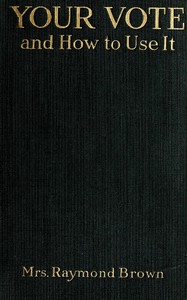
Gertrude Foster Brown, writing as chairman of organization for the New York State Woman Suffrage Party, produced this manual in 1918, the year after New York women gained full voting rights. The book’s foreword by Carrie Chapman Catt frames it as a practical tool for new voters, but the contents reveal a broader ambition: to explain the entire apparatus of American government, from town meeting to Supreme Court, with a consistent focus on New York State’s particular structures. Brown’s prose is direct and instructional, avoiding rhetorical appeals in favor of procedural clarity.
A Suffrage Organizer’s Government Primer
The book’s table of contents reads like a civics syllabus, moving from local to national government across ten chapters. Brown devotes separate chapters to town and county government, incorporated villages and cities, Greater New York, state government, and national government. This laddered structure mirrors the progressive-era belief that informed citizenship begins with the nearest level of administration. The chapter on Greater New York, for instance, lists specific offices—mayor, comptroller, president of the board of aldermen, borough presidents—and explains the board of estimate and apportionment, a body peculiar to the city’s charter. Such detail suggests Brown expected her readers to vote in New York City elections and needed to know exactly which officials controlled budgets and appointments.
Courts, Injunctions, and Constitutional Limits
Brown’s treatment of the judiciary is notably thorough. She describes the New York Court of Appeals as composed of a chief judge and nine associates, with only seven sitting at one time, and explains that it reviews only questions of law, not fact, except in capital cases. She then turns to federal courts, outlining the district courts, circuit court of appeals, and Supreme Court. A striking passage defines an injunction and notes that violators can be arrested and jailed for contempt without a jury trial, adding that “many efforts have been made to limit this power of the courts.” This remark, placed in a manual for new voters, hints at contemporary labor disputes and progressive-era concerns about judicial overreach, though Brown does not elaborate.
New York Specifics as a Teaching Tool
Throughout the excerpts, Brown anchors general principles in New York examples. She explains that the state constitution is the fundamental law, subject to interpretation by courts, and that a law may be declared void if it violates that constitution. The section on courts distinguishes between courts of record—those with an official seal—and justices’ courts, which are not. She also details the surrogate’s court, county court, and supreme court’s appellate divisions. This granularity serves a dual purpose: it teaches the structure of New York’s judiciary while modeling how a citizen might trace a legal question from local to state to federal level. The book’s catalog subjects list both United States and New York politics, and the excerpts confirm that Brown treats the state as the primary laboratory for civic education.
Readers should approach this manual as a period document shaped by the immediate needs of newly enfranchised women in New York State. Brown’s emphasis on procedural detail—how a law is passed, how courts are organized, what an injunction does—reflects the suffrage movement’s conviction that voting required not just the right but the knowledge to exercise it effectively. The book’s narrow focus on New York’s institutions makes it less a general civics text than a tailored guide for a specific electorate at a specific moment.
That old manual made me think about how patient those women were, explaining every lever of government so carefully. It has the same quiet determination I felt reading Australasian Democracy — Reading Notes, where the machinery of voting feels almost tender in its detail. Both left me with a strange fondness for civic process, like remembering someone’s handwriting.