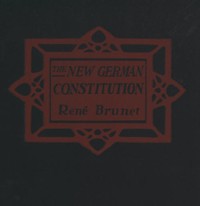
René Brunet, a professor of constitutional law at the University of Caen and former legal advisor to the French Embassy in Berlin, brings a comparative jurist's eye to the Weimar Constitution. His analysis, translated by Joseph Gollomb and introduced by Charles A. Beard, systematically examines the document's articles, often contrasting them with French and Anglo-Saxon practices. Beard's foreword praises Brunet's 'scientific spirit' and 'first-hand knowledge' of the post-1918 German political landscape.
A French Scholar's Method
Brunet's approach is distinctly comparative. He frequently draws parallels to French constitutional law, as when he notes that in Germany 'it is not the chief of state who has the initiative in laws but the Council of Ministers'—a contrast to French practice. His analysis of the Cabinet's ordinance powers distinguishes three types of regulations, each tied to specific articles (77, 88, 91). This meticulous parsing of legal authority reflects his training in French administrative law.
Beard's foreword underscores Brunet's 'impartial and thorough-going study' begun 'hardly over' after the November 1918 revolution. The translator, Joseph Gollomb, renders Brunet's French into clear, precise English, preserving the legal nuance. The text is dense with article numbers and procedural details, demanding careful reading.
The Architecture of Executive Power
Brunet devotes considerable attention to the Chancellor and Ministers. He explains that Article 54 requires each minister to resign if the Reichstag withdraws confidence, but he argues this does not imply individual responsibility alone. Comparing Article 54 with Article 56, he infers a collective responsibility: the Chancellor answers for 'principles and plans of great scope,' while ministers answer for their departments. This interpretation, he notes, is not explicit in the text but emerges from reading the articles together.
He also details the Cabinet's power to issue ordinances with the force of law under the April 17, 1919 law, requiring consent from the Reichsrat and a special committee. This delegation of legislative authority, Brunet suggests, was a transitional measure for economic regulation.
The Reichsrat and Federal Dynamics
Brunet examines the Reichsrat's role in the legislative process. He notes that certain Cabinet regulations require its approval, citing Articles 88, 91, and 77. The Reichsrat, representing the states, thus acts as a check on central executive power. Brunet's analysis is grounded in specific constitutional clauses, avoiding broad generalizations about federalism.
He also discusses the enumeration of matters that must be decided by the Council of Ministers, including all projects of law and inter-departmental disputes. This procedural detail reveals the framers' intent to ensure collective deliberation on major policies.
The Translator's Role and Textual Clarity
Joseph Gollomb's translation renders Brunet's French legal prose into English that is both accurate and readable. The text retains the original's systematic structure, with numbered lists and article references. For instance, Brunet's three-part classification of Cabinet regulations—simple regulations, those requiring Reichsrat approval, and those with force of law—is presented clearly.
The translation occasionally uses French-influenced phrasing, such as 'veritable laws' for what might be termed 'actual laws.' This slight foreignness reminds the reader of the work's origin. The foreword by Charles A. Beard, a prominent American political scientist, adds credibility and frames the book as a model of 'scientific spirit' for American writers.
Readers approaching this work should be prepared for a dense, article-by-article commentary that assumes familiarity with constitutional terminology. Brunet's comparative perspective—especially his contrasts with French practice—offers insight into how a foreign jurist read the Weimar document. The book is best used alongside the Constitution itself, as Brunet's arguments often hinge on the interplay between specific articles.
There’s something touching about René Brunet’s careful, almost tender dissection of the Weimar Constitution, a Frenchman trying to understand a republic already trembling. It reminds me of an old, dog-eared copy of The government class book Designed for the instruction of youth in the principles of constitutional government and the rights and duties of citizens. — A Reader’s Guide I once found at a library sale, its earnest lessons feeling equally like a letter from a more hopeful time.