About 3,335 minutes
Abridgment of the Debates of Congress, from 1789 to 1856, Vol. 4 (of 16) — Reading Companion
Government
766,967 recorded words. 106 minutes difference from this book's estimate.
View Gutenberg source #47289
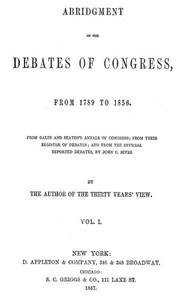
The source record for Abridgment of the Debates of Congress, from 1789 to 1856, Vol. 1 (of 16) — Story, Setting & Ideas measures this digital text at 791,406 words, 57 hr 21 min estimated reading time, and 90 detected text sections.
The text analysis averages about 27.6 words per sentence, while the detected sections provide another way to judge how the source is divided.
Project Gutenberg metadata also associates the work with “United States -- Politics and government,” connecting these edition facts with the source record’s subject description.
Explore this collection
These alternatives are selected using recorded categories and estimated reading time.
About 3,335 minutes
Government
766,967 recorded words. 106 minutes difference from this book's estimate.
View Gutenberg source #47289About 3,301 minutes
Government
759,190 recorded words. 140 minutes difference from this book's estimate.
View Gutenberg source #40851About 3,268 minutes
Government
751,591 recorded words. 173 minutes difference from this book's estimate.
View Gutenberg source #54345Search stored excerpts and compare books → Choose by your preferences →
Choices use stored catalog measurements. Estimates vary with reading speed. A shared category is a catalog label, not a claim that two books have the same argument or literary quality.
Search reads excerpt text stored with this catalog and links to its associated Gutenberg record. The connection is stored in the site database; this tool does not recheck that every excerpt is word-for-word identical to that external record. Excerpt search does not cover every chapter and does not verify historical publication dates.
Catalog snapshot checked: 2026-09-25. Coverage: 90 public books, 90 available source excerpts.
Read the complete public-domain text at its original source.
Read on Project GutenbergThis volume opens with a preface by Thomas Hart Benton that establishes the editorial lineage of the work. Benton, a former U.S. Senator, explains that the abridgment draws from three authoritative sources: Gales and Seaton's Annals of Congress (a compilation), their Register of Debates, and the official Congressional Globe reported by Blair and Rives. He emphasizes that the Annals were compiled by Joseph Gales Jr., whom John Randolph called “the most perfect reporter he had ever known,” and that the compilers had access to earlier reports from the 1790s collected by Joseph Gales Sr. The preface thus frames the abridgment as a distillation of trusted records, not a new historical interpretation.
Benton’s preface reveals a deliberate editorial approach. He notes that the Annals were compiled from contemporary newspaper accounts and private notes, while the later Register and Globe were original reports revised by speakers. By combining these, Benton aimed to produce a condensed but accurate record. The excerpts show that the abridgment preserves roll-call votes (e.g., 48 yeas, 7 nays on the Fugitive Slave bill) and procedural details such as committee reports and teller appointments. However, the preface does not specify how much speech text was cut or whether Benton added commentary. Readers should treat the abridgment as a selection, not a complete transcript.
The excerpts from February 1793 illustrate the formal procedures of the early Congress. On February 5, the House considered a Senate bill “respecting fugitives from justice and persons escaping from the service of their masters,” passed it with an amendment, and ordered it to lie on the table. On February 11, a joint committee reported a mode for examining presidential electoral votes, including the appointment of tellers. On February 13, the House withdrew to the Senate Chamber to witness the counting of votes and the declaration of the President and Vice President. These entries show that the abridgment retains the step-by-step legislative process, including messages between chambers, resolutions, and the recording of vote lists.
The February 5, 1793 entry records the passage of “An act respecting fugitives from justice and persons escaping from the service of their masters.” The roll call lists 48 yeas and 7 nays, with names such as Fisher Ames, Abraham Baldwin, and Elbridge Gerry voting in favor, while Samuel Livermore and George Thatcher voted against. The excerpt provides no floor speeches or debate text, only the final vote. This suggests that Benton’s abridgment often omits the arguments that preceded key legislation. Readers interested in the reasoning behind the Fugitive Slave Act of 1793 would need to consult the original Annals or other sources for the full debate.
Benton’s abridgment offers a structured entry into the first eight years of Congress under the Constitution, but it is not a substitute for the full record. The volume’s value lies in its preservation of procedural motions, committee reports, and roll-call votes that might otherwise be buried in longer transcripts. For researchers, it serves as a finding aid: the headings and dates allow quick location of specific events, while the missing speeches remind us that the abridgment is a curated selection, not a neutral mirror of congressional history.
Reading about those early roll-call votes in Benton’s abridgment, I felt the weight of each procedural motion. It reminded me of another old volume, Government and Administration of the United States — Context and Discussion, which sits quietly nearby. There is a comfort in seeing how the machinery was assembled, then described, almost like attending to the same steady house.
Capture what you thought, learned, and would like to remember.









