About 3,301 minutes
Abridgment of the Debates of Congress, from 1789 to 1856, Vol. 2 (of 16) — Text and Context
Government
759,190 recorded words. 34 minutes difference from this book's estimate.
View Gutenberg source #40851
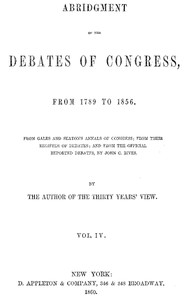
For Abridgment of the Debates of Congress, from 1789 to 1856, Vol. 4 (of 16) — Reading Companion, the stored edition analysis reports 766,967 words, 55 hr 35 min estimated reading time, and 87 detected text sections.
The text analysis averages about 26.7 words per sentence, while the detected sections provide another way to judge how the source is divided.
Project Gutenberg metadata also associates the work with “United States -- Politics and government,” connecting these edition facts with the source record’s subject description.
Explore this collection
These alternatives are selected using recorded categories and estimated reading time.
About 3,301 minutes
Government
759,190 recorded words. 34 minutes difference from this book's estimate.
View Gutenberg source #40851About 3,268 minutes
Government
751,591 recorded words. 67 minutes difference from this book's estimate.
View Gutenberg source #54345About 3,441 minutes
Government
791,406 recorded words. 106 minutes difference from this book's estimate.
View Gutenberg source #40499Search stored excerpts and compare books → Choose by your preferences →
Choices use stored catalog measurements. Estimates vary with reading speed. A shared category is a catalog label, not a claim that two books have the same argument or literary quality.
Search reads excerpt text stored with this catalog and links to its associated Gutenberg record. The connection is stored in the site database; this tool does not recheck that every excerpt is word-for-word identical to that external record. Excerpt search does not cover every chapter and does not verify historical publication dates.
Catalog snapshot checked: 2026-09-25. Coverage: 90 public books, 90 available source excerpts.
Read the complete public-domain text at its original source.
Read on Project GutenbergThis fourth volume of Thomas Hart Benton's abridgment spans the Tenth through Twelfth Congresses (1808–1813), a period when the young republic navigated the Napoleonic Wars. The excerpts reveal a striking shift in rhetorical pace: Senate proceedings open with dry, procedural roll calls of members present, while House debates soon escalate into impassioned oratory. One speaker, for instance, dissects the Duc de Cadore's letter with a sustained metaphor, calling it a "honeyed charm" leading into a "labyrinth"—a vivid departure from the preceding factual tone. This contrast between bureaucratic record and fiery speech defines the volume's narrative voice.
The volume begins with the Senate's second session of the Tenth Congress on November 7, 1808. The entry is purely administrative: it notes the session's start "conformably to the act" and lists attending senators by state. The language is stripped of emotion—names like "George Clinton, Vice President" and "Timothy Pickering, from Massachusetts" appear without commentary. This opening establishes a baseline of official record-keeping, where the pace is slow and the voice impersonal. Such passages serve as a counterpoint to the more animated debates that follow, highlighting how Benton's abridgment preserves both the mundane and the dramatic.
In a House debate, a speaker attacks the French government's letter of August 5, 1810, with elaborate rhetoric. He describes it as a "gilded pill" containing "deadly venom" and accuses the Emperor of offering a "promise, and that too clogged with conditions." The speech shifts from legal analysis to metaphorical condemnation, using phrases like "fell monster of the age" to characterize Napoleon. This passage demonstrates how orators could abruptly change pace, moving from careful parsing of diplomatic language to visceral imagery. The speaker's reliance on a single sentence of "plain truth" within the letter underscores the tension between evidence and persuasion.
Benton's arrangement creates a rhythm: each congressional session opens with Senate proceedings (often brief and factual), then moves to House debates (longer and more argumentative). Within the House sections, individual speeches can vary widely in tone. The excerpt from the Cadore debate, for example, is a single sustained argument, while other passages (not shown) likely include shorter exchanges. This structural alternation—between chambers and between modes of discourse—gives the volume a layered pace. Readers encounter the formal listing of names, then the charged language of partisan conflict, then back to procedural motions, mimicking the actual ebb and flow of legislative work.
Readers approaching this volume should attend to the interplay between its two dominant voices: the neutral recorder of Senate minutes and the impassioned advocate in House debates. Benton's abridgment does not smooth these contrasts; instead, it preserves them, offering a documentary record where shifts in pace and register are themselves historical evidence. The volume rewards those who listen for the change in tone as much as the content of the arguments.
I have always been moved by how the old congressional debates linger over a single metaphor, stretching it until it holds the weight of policy. That same patient intimacy lives in Politics of Alabama — Context and Discussion, where the procedural and the personal breathe together. They share a quiet trust that place shapes argument, and argument remembers place.
Use these questions to collect your thoughts before moving on.









