About 3,268 minutes
Abridgment of the Debates of Congress, from 1789 to 1856, Vol. 3 (of 16) — Context and Discussion
Government
751,591 recorded words. 33 minutes difference from this book's estimate.
View Gutenberg source #54345
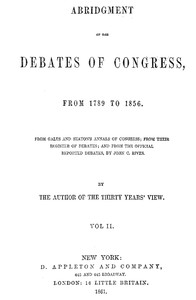
This digital edition of Abridgment of the Debates of Congress, from 1789 to 1856, Vol. 2 (of 16) — Text and Context is described by source-level measurements including 759,190 words, 55 hr 1 min estimated reading time, and 93 detected text sections.
The text analysis averages about 25.8 words per sentence, while the detected sections provide another way to judge how the source is divided.
Project Gutenberg metadata also associates the work with “United States -- Politics and government,” connecting these edition facts with the source record’s subject description.
Explore this collection
These alternatives are selected using recorded categories and estimated reading time.
About 3,268 minutes
Government
751,591 recorded words. 33 minutes difference from this book's estimate.
View Gutenberg source #54345About 3,335 minutes
Government
766,967 recorded words. 34 minutes difference from this book's estimate.
View Gutenberg source #47289About 3,441 minutes
Government
791,406 recorded words. 140 minutes difference from this book's estimate.
View Gutenberg source #40499Search stored excerpts and compare books → Choose by your preferences →
Choices use stored catalog measurements. Estimates vary with reading speed. A shared category is a catalog label, not a claim that two books have the same argument or literary quality.
Search reads excerpt text stored with this catalog and links to its associated Gutenberg record. The connection is stored in the site database; this tool does not recheck that every excerpt is word-for-word identical to that external record. Excerpt search does not cover every chapter and does not verify historical publication dates.
Catalog snapshot checked: 2026-09-25. Coverage: 90 public books, 90 available source excerpts.
Read the complete public-domain text at its original source.
Read on Project GutenbergThe second volume of Thomas Hart Benton's abridgment opens with the Fourth Congress's second session in December 1796, immediately immersing the reader in the Senate's procedural machinery. The text records the reading of credentials, administration of oaths, and the formal announcement of a quorum—a rhythm of governance that sets the tone for the volume. Yet the excerpts also contain a striking shift: a lengthy, first-person diplomatic report from American ministers in France, detailing tense negotiations with agents X, Y, and Z. This juxtaposition of dry parliamentary routine with high-stakes international dialogue defines the volume's narrative voice, which oscillates between the impersonal language of official records and the urgent, defensive prose of diplomatic correspondence.
The opening pages of this volume are dominated by the Senate's formalities: the reading of credentials, the swearing-in of new members, and the communication of resignations. The language is repetitive and formulaic—"The credentials of the after-named Senators were severally read"—creating a steady, almost rhythmic pace that mirrors the deliberate tempo of legislative business. This procedural voice is not merely bureaucratic; it conveys the young republic's emphasis on order and legitimacy. The text records each senator's name, state, and predecessor, building a catalog of political succession. For readers, this section functions as a primary source on early congressional operations, where the act of naming and seating becomes a ritual of authority.
In stark contrast to the Senate's measured proceedings, the volume includes a detailed, first-person account of negotiations with French agents. The narrative voice becomes immediate and defensive: "We told him that, on the subject of the treaty, we had no hesitation in saying that our powers were ample." The pace quickens as the American ministers parry demands for loans and reparations, recording their own replies verbatim. The language is precise and legalistic, yet charged with frustration—"M. Y. expressed himself vehemently on the resentment of France." This section offers a rare glimpse into the raw, unedited dialogue of early U.S. diplomacy, where every word is weighed and every concession resisted.
The volume's pacing is shaped by its editorial method: Benton abridges but preserves the sequential, day-by-day structure of congressional debates. The result is a text that moves slowly through procedural minutiae—adjournments, quorum calls, committee appointments—then accelerates during moments of debate or crisis. The diplomatic excerpt exemplifies this: it begins with a measured exchange, then builds tension as the ministers refuse to yield. Repetition of phrases like "we could not help it" and "it was for us to guard the interest and honor of our country" reinforces the stalemate. This variation in tempo is not accidental; it reflects the rhythm of governance itself, where long stretches of routine are punctuated by bursts of conflict.
Readers approaching this volume should attend to its dual voices: the impersonal, procedural language of the Senate and the urgent, first-person accounts of diplomatic confrontation. The abridgment preserves the original documents' pacing, making it possible to trace how the young republic's leaders spoke and wrote under pressure. This is not a polished history but a raw transcript of governance, where every adjournment and every negotiation reveals the character of early American political culture.
Some evenings I page through these old debates, and the cadence of forgotten speeches reminds me how much our political voice has tightened since. There is a slowness there, a patience we have lost. The same unhurried tone lingers in State of the Union Addresses — Inside the Classic, where each address feels like a letter from another century, left open on a desk.
Use these questions to collect your thoughts before moving on.









